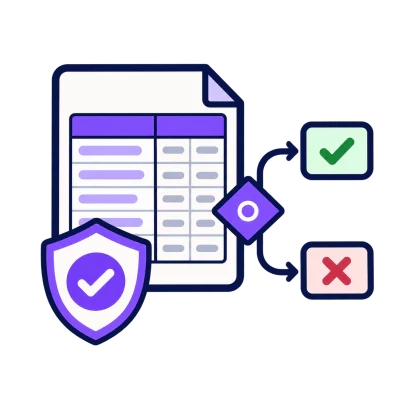
Common SEFA mistakes
Most SEFA problems are omissions rather than arithmetic: a pass-through award without the pass-through entity's identifying number, a missing Assistance Listing number, loans left off, or cash received reported instead of awards expended. Each one is measured against the elements required by 2 CFR 200.510(b).
Last verified: 2026-09-20 · Every figure links its source.
What are the most common SEFA mistakes?
| Mistake | What the rule requires | Fix |
|---|---|---|
| Pass-through award listed without the pass-through entity | The name of the pass-through entity and the identifying number it assigned | Ask the state or city for the subaward identification in writing before year end |
| Wrong or outdated Assistance Listing number | Programs identified by federal agency using the applicable Assistance Listing numbers | Confirm the number on the award document, not from last year's schedule |
| A cluster split into separate programs | Cluster names must be shown where applicable | Check the cluster list in the Compliance Supplement for the audit period |
| Cash received reported instead of expenditures | Total federal awards expended, determined by when the activity occurs | Reconcile to the general ledger on the expenditure basis |
| Loans omitted, or the outstanding balance note missing | Loan balances outstanding at the end of the audit period, identified in the notes | Add the loan note; value loans under 200.502(b) |
| Subaward column empty although money was passed on | The total amount provided to subrecipients from each federal program | Pull subrecipient payments by program from the ledger |
| No note on the de minimis indirect cost rate | A note stating the significant accounting policies and whether the de minimis rate of up to 15 percent was elected | Add the policy note, even when the answer is no |
Source: 2 CFR 200.510 · 2 CFR 200.502 · OMB Compliance Supplement · Last verified: 2026-09-20
Why do SEFA errors become audit findings?
Because the schedule is not decoration: the auditor gives an in-relation-to opinion on it (2 CFR 200.515(a)), and the major program determination is calculated from it (200.518). An understated schedule can mean the wrong programs were tested; an overstated one can mean unnecessary testing. Reporting under the wrong requirement type is also how questioned costs end up misclassified.
For scale, 3,631 of 22,398 nonprofit single audits for audit year 2024 reported at least one finding of any kind (16.2%); our per-state breakdown is on the statistics pages.
Source: 2 CFR 200.515 · 2 CFR 200.518 · Federal Audit Clearinghouse · Last verified: 2026-09-20
How should loans and non-cash awards appear?
Loans are valued as new loans made during the period plus prior balances that still carry compliance requirements, together with interest subsidies and administrative cost allowances (2 CFR 200.502(b)); the outstanding balance goes in the notes (200.510(b)(5)). Non-cash assistance — commodities, property, insurance — is valued under the same section and reported like any other award.
Source: 2 CFR 200.502 · 2 CFR 200.510 · Last verified: 2026-09-20
How do you reconcile the SEFA to the general ledger?
- Start from grant revenue and expenditure accounts, not from the cash account.
- Map every federal award to its Assistance Listing number and its pass-through entity.
- Agree the expenditure total per program to the ledger, and document the difference where the ledger is on a different basis.
- Tie the subaward column to payments made to subrecipients.
- Keep the reconciliation itself — the auditor will ask for it, and next year it halves the work.
Source: 2 CFR 200.510 · 2 CFR 200.508 · Last verified: 2026-09-20
Questions and answers
What is the most common SEFA error?
Reporting a pass-through award without naming the pass-through entity and the identifying number it assigned, which 2 CFR 200.510(b) requires for every award received as a subrecipient.
Does a SEFA error always cause a finding?
No, but it can. The auditor gives an in-relation-to opinion on the schedule and uses it to determine major programs, so a material error affects both.
Fixing the schedule before fieldwork? Use the audit checklist.
This is public-record information, not accounting or legal advice.