Building a practice in one state
Buy one Territory Report, read the ranked accounts, and decide whether nonprofit single audit work is worth pursuing before starting a subscription.
AuditRadar monitors public Single Audit records and public solicitations, detects meaningful account changes, and organizes them into a territory-level review workflow for CPA firms. Every signal is tied back to public evidence.
Last verified: 2026-09-22 · Public-record nonprofit audit intelligence for CPA firms.
Preview my state See the sample report
No invented purchase intent. No hidden source. Your firm decides what is worth pursuing.
This is the sequence a partner or a BD lead repeats for every account worth a second look. Nothing in it is difficult; all of it is slow, and none of it is reusable next quarter.
These are descriptions of how the product can be used. They are not case studies, and no client has been quoted: AuditRadar publishes a customer quote only where a signed consent document exists (03_01 §20.10).
Buy one Territory Report, read the ranked accounts, and decide whether nonprofit single audit work is worth pursuing before starting a subscription.
Filter for accounts that crossed the federal threshold or grew their federal spend, which is where the larger single audit work sits.
Let the Thursday digest report what changed, instead of rebuilding the same search every quarter.
See which firms are observed on which filings across your states, and which accounts nobody in your comparison set is holding.
The Federal Audit Clearinghouse publishes every single audit. It does not tell you which accounts in your territory changed auditor, entered single audit for the first time, crossed the federal threshold or picked up a new finding — that comparison is manual, filing by filing, year against year.
AuditRadar does not replace professional judgment. It organizes public evidence so your team can review it faster.
Observed: The most recently observed Single Audit filing names a different primary auditor than the prior comparable filing.
Why review it: It is recent, public provider movement in your territory.
Does not mean: It does not mean the organization is currently seeking another auditor or is running a procurement.
Evidence: Both filings on app.fac.gov, the audit year of each, and the name observed on each. How this is calculated
Observed: A Single Audit filing appears for this organization for the first time in the comparison history AuditRadar holds.
Why review it: A first single audit usually means new federal funding and new compliance work.
Does not mean: “First observed” is not proof that no earlier audit exists outside the available records.
Evidence: The filing on app.fac.gov and the audit year it was accepted for. How this is calculated
Observed: Federal expenditures moved from below to at or above the Single Audit threshold that applies to that fiscal year — $750,000 for a fiscal year beginning before October 1, 2024 and $1,000,000 for one beginning on or after it.
Why review it: The organization has entered Single Audit scope for the first time in the observed period.
Does not mean: It does not mean the organization missed a requirement, or that it is looking for a new firm.
Evidence: The expenditure total on each filing and the fiscal year each covers. How this is calculated
Observed: Federal expenditures on the latest filing are at least 1.5 times the prior comparable filing, and the increase is at least $500,000. Figures are nominal, as reported.
Why review it: A larger federal program footprint usually means more major programs to audit.
Does not mean: It does not mean the current engagement is at risk or that the audit fee has changed.
Evidence: The expenditure totals on both filings, with the year each covers. How this is calculated
Observed: The latest filing reports a material weakness that was not reported in the prior comparable filing.
Why review it: A new material weakness is a change in the control environment the next audit has to address.
Does not mean: It does not mean the audit was performed poorly, nor that the organization wants a different auditor.
Evidence: The findings section of both filings on app.fac.gov. How this is calculated
Observed: The latest filing reports a significant deficiency that was not reported in the prior comparable filing.
Why review it: It is a public, dated change in what the auditor reported about internal control.
Does not mean: It does not mean the organization broke a rule, or that it is changing auditor.
Evidence: The findings section of both filings on app.fac.gov. How this is calculated
Observed: The latest filing reports material noncompliance that was not reported in the prior comparable filing.
Why review it: Compliance findings add scope to the following year's single audit.
Does not mean: It does not mean an enforcement action exists, or that the organization is procuring audit services.
Evidence: The findings section of both filings on app.fac.gov. How this is calculated
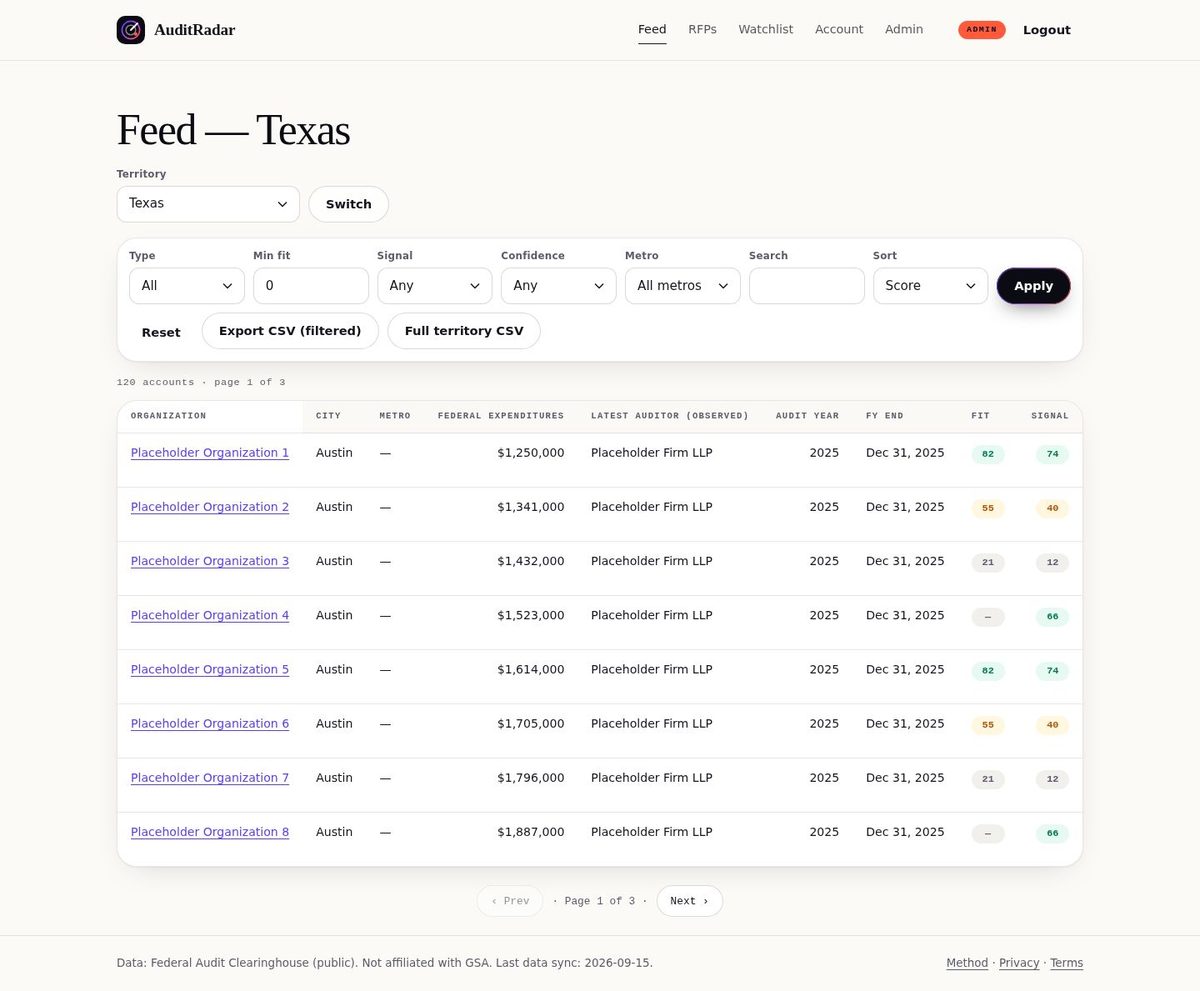
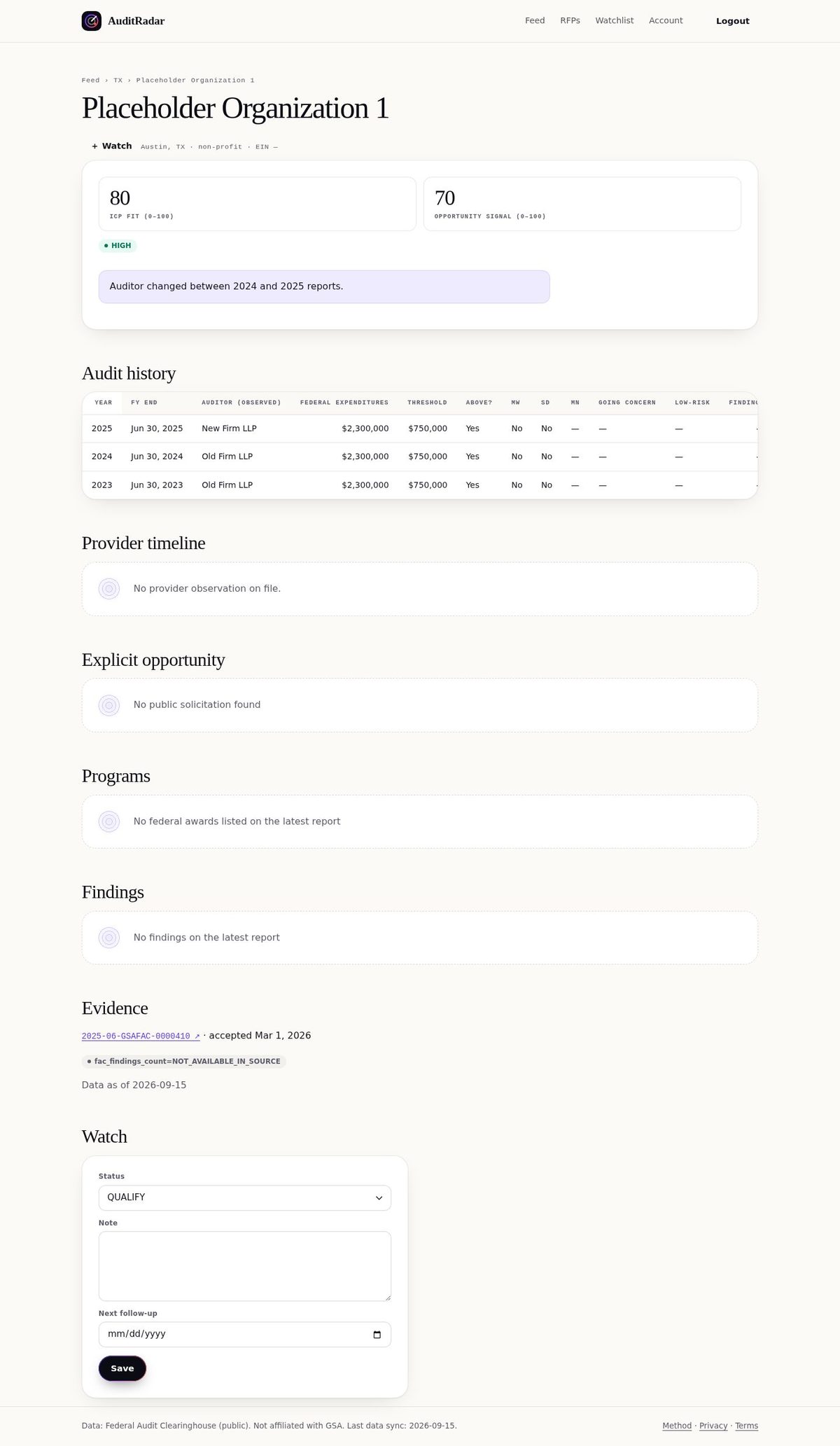
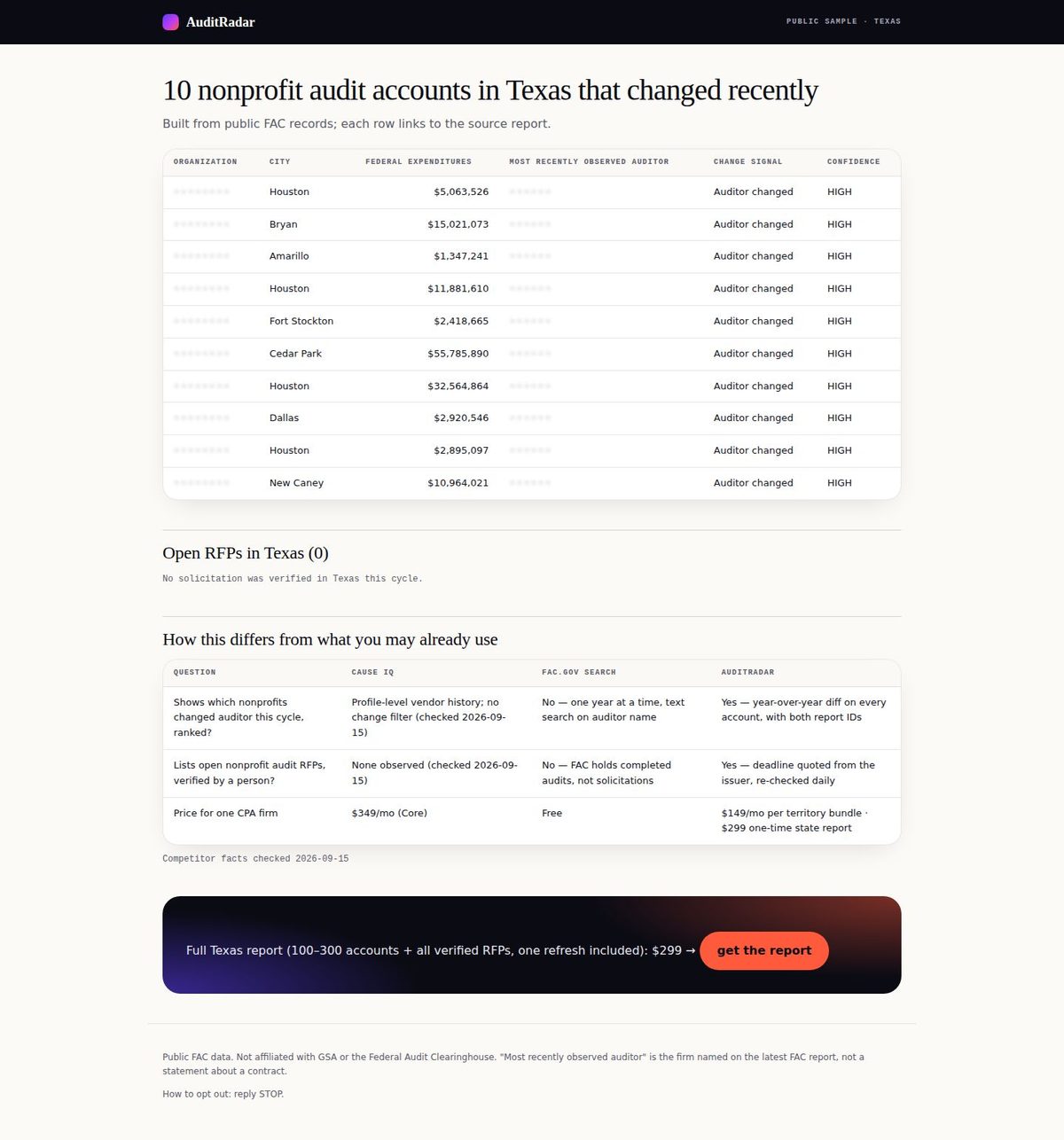
Download the sample files — a redacted build of the real Texas report, as of 2026-09-22: XLSX · PDF · CSV · HTML. Organization names and EINs are masked below row 10; every other column, score and evidence link is the production one.
Open the full product tour, read how accounts are ranked, or check how fresh each source is.
Give me one complete state to review now.
Who should I review now?
$299 one-time
Best first purchase if you want to evaluate the full territory output before subscribing.
Keep my territory monitored instead of rebuilding the research manually.
Tell me when my territory changes.
$447 per 3 months ($149/mo)
For firms that want the same territory monitored instead of periodically rebuilding the research.
Maintain an active multi-territory pursuit list.
Help me pursue the opportunities that match my firm.
$249/mo
For active business-development workflows spanning two territory bundles.
Map multiple states, incumbents and whitespace as a team.
Map our market, the incumbents and the whitespace.
$449/mo
For teams that need broader territory coverage and the Firm-only analysis and export capabilities.
Evidence, not invented intent. AuditRadar shows observable public-record changes and the source behind them. Your firm decides which accounts are worth pursuing.
The Federal Audit Clearinghouse publishes every single audit. It does not tell you which accounts in your territory changed auditor, entered single audit for the first time, crossed the federal threshold or picked up a new finding — that comparison is manual, filing by filing, year against year. AuditRadar does not replace professional judgment. It organizes public evidence so your team can review it faster.
One state, ranked by public-record change: up to 300 accounts, the signal behind each one, the most recently observed auditor, federal expenditure context, the incumbent landscape, verified open RFPs when an issuer has published one, and a link to the filing behind every supported row. It arrives as XLSX, CSV, PDF and HTML, plus a data dictionary that defines every column, and you can ask once within 30 days for a rebuild on a newer extract.
No. An auditor change means the most recently observed filing names a different primary auditor than the prior comparable filing. It does not mean the organization is currently seeking another auditor or is running a procurement. AuditRadar shows observable public-record changes and the source behind them; your firm decides which accounts are worth pursuing.
Start where the evidence is: open a live state preview or compare the four plans.